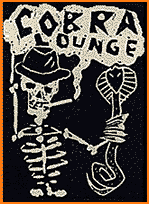
HISTORY OF COBRA LOUNGE
|
Prior
to 1986. When I was in high school, I got the chance to produce the annual talent show. Not having any kind of training to fall back on, I just winged it, writing and directing with an eye on what made my friends and I laugh, and filling the breaks in the story with whatever talent we could round up and reframe. In the seventies, as a journeyman actor, I focused on physical theater, circus, music, singing and composition, a bit of dance and some puppetry. I had little clue what I wanted to do. I was short on ambition and very long on dreams. I moved from Chicago to San Francisco in the mid-seventies, and soon had helped form a small circus troupe - Jolly Wally's Wonder Follies. We performed in schools, at street fairs, in the park. We built a big wooden wagon and traveled around California in it. We were having a great good time.
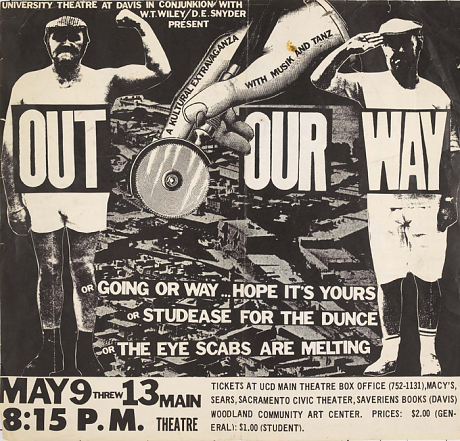
It was not long after that, that I had what I'd call a breakthrough experience. I was acting at the time in a Michael McClure musical play called "Minnie Mouse and the Tap-Dancing Buddha." I was playng the Buddha, and one night the painter William T. Wiley along with a friend, painter and set designer named Dan Snyder saw the show and afterwards invited myself and my friend Peter Kors, who was playing Mickey Mouse, to come up to UC Davis (where they both taught) for an upcoming "Out Our Way" show. OOW shows I would soon discover were giant "art" vaudevilles show that the two of them co-produced.
It proved
to be the most influential of evenings. I saw the vaudeville form used
with more flexibility than I had ever imagined. With the kind of anarchistic
freedom that only painters can bring to the theater, I saw it stretched
and pulled in ways that I could honestly say, mirrored my dreams. The
event was staged on a big stage at UC Davis. Some examples of the range
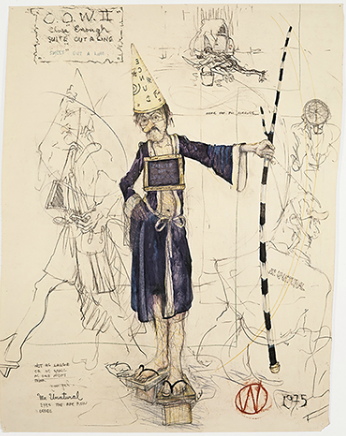
of performances. • The curtain was raised to a height of two feet. From the back of the stage, eight cans of Chef Boy-ar-Dee Spaghetti rolled downstage and into the pit, as the curtain was lowered. • Bill Morrison had built a giant balsa wood and red paper ship which he careened around the stage until he had destroyed it. • Rik Myslewski atop a two story tall cart, recited Joseph Conrad as he and the cart fell over the edge of the stage and into the orchestra pit. • Once again the curtain was raised revealing six slowly deflating rubber ducks. • Art Junker, in his Bodhi Chicken suit, sang and played piano. • I remember Snyder with his spyglass standing in one of two on-stage lifeboats, searching for land while we "actors" did our best to improvise an ending to the scene. • There at the side of it all, was Wiley in his Mr. Unnnatural costume; a boxer's robe, high Japanese platform shoes, a false nose, a pointy dunce cap, and a black and white striped staff.
I was on fire for weeks afterwards. I understood that this was a form that I could make speak. This was my kind of theater. ART Vaudeville. I had always felt mostly removed from the theater tradition - too serious, especially the comedies ... and the musicals, forget about it. Now I understood why. The tradition that I had sprung from was not theater. It was visual art and circus and its eclectic antecedents were clear. Commedia
del'Arte, Alfred
Jarry, Early Film, Dada Cabaret |
After
1986 It was a stellar community of daring souls, unfazed by a lack of funds or critical attention. In the course of one of those benefits, we began joking that perhaps we should do a benefit for ourselves. Sure, I said, we'll call it COBRA LOUNGE, and it will be dark, smoky and happen late at night ... and we'll do what whatever we want for five minutes each -nothing lasts longer than five minutes. I had already teamed up with my life-long friend, painter and sculptor John Mayne to concoct a set and for help with my costume - which he lent brillliantly. John was game and so together we began! Phonecalls were made, beer was bought, and thus was the unholy anarchy unleashed. Within a
week, I had arranged the first COBRA LOUNGE. It would take
place at the Hawkeye's Berkeley space ... 2019 Blake Street at midnight. That was followed
by a show the next weekend at the Intersection in San Francisco on Valencia Street. Over the course of the next 6 years, COBRA LOUNGE was performed around twice a year in progressively larger venues. The company we kept was legendary. There was the San Francisco crew from Dude Theater; Chris Brophy, Paul Codiga, C.W. Morgan, Susan Brecht & Cintra Wilson. There was Roger Niebohr, Amy Brosnahan & Tom Ford from Davis, protégés of the great Snyder himself. There was the Faultline comedy gang, Mike McShane, Greg Proops, Brian Loehmann, Reid Rahlman, Barbara Scott & O-lan Jones. There was the Duck's Breath gang, Jim Turner & Merle Kessler. There were the wondrous musicians, J.A. Deane, Joshua Brody, Gina Leishman, Doug Weiselman and later Steven Bernstein, Peter Aphelbaum, Kenny Wolleson, Jeff Cressman & Beth Custer. There was the fabulous Wayne Doba, Derrique McGee, Larry Pisoni, Elbows Akimbo & Ze Fabulous Poodles, There were singers, Pamela Z, the Genuine Diamelles, the Edlos & the Ethel Merman Memorial Choir. Then there was also the ever-present Techno-Snake Sideshow and Extension Cord Festival ... which featured what I saw as the best in interactive, digital video and robotic art around... Ed Tannenabaum, Chico McMurtrie, Tim North were just some of the contributors. |
| TeleCircus | SpoonLife | pARTy/SCIENCE | Anon Salon | Audience Experience |
| | Contact: Mark "Spoonman" Petrakis | SiteMap | |